12.27.2010

Open new house celebration custom


In the past, building a house was considered one of the three most important events in Vietnamese life. These were purchasing a buffalo, looking for a wife, and building a house. So building an own house is very important to Vietnamese. It even shows his position in social structure. Vietnamese who die without ever has his own house is considered poor and disadvantaged.

Open house celebration is a popular customs of Vietnamese. All of friends, relatives and neighbors are invited to a party to share with the house owner happiness. After the party all guests give gifts normally a little money to house owner and also best wishes for health, happiness and a prosperous life.

12.15.2010

Ethnic minority communenities in Vietnam


Life in remote, ethnic minority communenities in Vietnam can be a struggle to survive. The difficulties in the lives of ethnic minorities are many fold: child malnutrition, no year round access to clean water, a general lack of hygienic latrines, lack of information and language difficulties which result in lesser opportunities, poor quality of education and health care.

Although the efforts by the Vietnamese government to alleviate poverty have been recommendable, still pockets of poverty, especially in ethnic minority areas, remain.

In order to help the Government, the EC together with the Non-Governmental Organisations ‘Enfants et Developpement' and ‘Save the Children UK', joined the efforts of local communities and teachers to develop a child friendly community and to alleviate poverty in two districts in Lao Cai and Quang Ninh province respectively in the North of Vietnam.

Before the project started in 2003, still a large number of school-age children, especially girls, were out of school in these districts. Moreover, less than half of the kindergarten-age children were attending kindergarten, most women were illiterate and could not speak Vietnamese, out-of-school children were forced to work long hours in the fields, often in cold and unhygienic conditions, informal and extra-curricular education was also very limited and children had very few safe place to play.

Quan ho singing


Hát Quan Họ was born about the 13th century in the Bắc Ninh province and was always heard during spring festivals, especially of the Buddhists. Bắc Ninh is the province where numerous pagodas were built, therefore, big Buddhist offering ceremonies were celebrated each year in spring. Boys and girls came to adore Buddha and after that, gathered together in front of or inside the pagoda orin the field to sing "Hát Quan Họ".

Originally Hát Quan Họ were exchange songs between two mandarins' families. Gradually, it spread out and became popular among the northern people. Groups were formed just for singing, and many marriages were formed at these get-togethers. After centuries, hát quan họ became the most significant vietnamese folk-song type.

Hát Quan Họ, also called Quan Họ Bắc Ninh singing, is an antiphonal singing tradition in which men and women take turns singing in a challenge-and-response fashion drawing on a known repertoire of melodies. Usually a pair of women starts, presenting in unison a complete song called câu ra (challenge phrase") lasting three to eight minutes. A pair of men of the opposing team responds with another song called câu đối ("matching phrase"), which must match the melody of the women's song in order to be considered correct. Next it will be the men's turn to challenge the women with a song that can be completely different from the previous pair of songs.

Apply Vietnam visa


When You want to visit to Vietnam. Getting Vietnam Entry VISA in not the most significant but it is the first task to be completed.

Now Vietnam is open and warmly welcoming foreigners to Vietnam. You can get a visa to Vietnam easy. There are two ways to apply for Vietnam visa: getting from Vietnam Embassy or Consulate in your country or ordering a visa service at a Travel Agent.

Vietnamvisaagent.com is a website which supply information about Vietnam visa, Vietnam travel news. It is so useful for foreigners who want to travel to Vietnam. Vietnamvisaagent give the tips that suggesting you how to get visa to Vietnam easiest, fastest and reliable but cheapest way. When you use our service, that is Legal, Quick, and Economical

Our service will respond and send your approval letter within only 1 or 2 day business day. The free is discount from 25 USD to 18 USD 1 letter/ 1 person.

Besides, in this occasion, welcome new year 2011, we have a program which is saved your money when you apply for a visa from our service.

Cost/Person
(USD)

Normal Processing

Urgent
Processing

Stamping
Fee

1-2 pax

3-5 pax

6-9 pax

10 pax upward

Single
entry

1 month

19 (18)

19 (16)

16 (14)

14 (13)

plus 10

US$25

3 months

35 (30)

33 (28)

31 (26)

28 (25)

plus 15

US$25


Multiple
entry

1 month

23

22 (21)

19 (18)

16

plus 15

US$50

3 months

40 (35)

38 (33)

36 (32)

30

plus 15

US$50


You can believe that we always work with experieces, responsibility and enthusiatic…. You will be pleasant when using our service.

Apply for a visa online through 4 easy steps

Fill in the online form

Confirm and pay

Get your stamp

That is it !


Get Vietnam Visa fastest
- Complete

+ Tourist visa
+ Business visa
+ Student visa

- Hassled-fee

+ No passport delivery
+ No photo required
+ No physical delivery

Please feel free to contact us:

Address:

10F, Charmvit tower, 117 Tran Duy Hung, Cau Giay, Ha Noi, Vietnam

Phone: (84) 974154297

Website: http://www.vietnamvisaagent.com

Email: dtquynh@vietnamvisaagent.com/ sales@vietnamvisaagent.com

Long bien Bridge


The first cultural and arts festival in memory of the Long Bien Bridge opened in Hanoi on October 10 by the Hanoi City People’s Committee.

The two-day festival, which was held to mark the 999 th birthday of Thang Long-Hanoi and the 55th anniversary of the Capital Liberation Day, opened a series of activities that aim to celebrate the 1,000th founding anniversary of Thang Long-Hanoi.

The 1,628-metre bridge, which spans the Hong (Red) River at the Hanoi area, is divided into 12 sections representing the 12 decades of its existence (1890-2009). Each section is covered with images created by domestic and foreign artists.

A wide range of cultural activities were held at the bridgeheads and along the historical bridge, such as painting, music, sculpture, circus, and traditional fashion show.

The release of 999 lanterns down the Red River will be included in the festival as a prayer for peace and prosperity for the city.

After the opening ceremony, participants joined a “Walk for Peace” to mark the 10 th year Hanoi has been recognised as a City for Peace by UNESCO.

Long Dress


The Ao Dai, literally meaning "long dress" or "long tunic," is one out of many traditional Vietnamese costumes worn (nowadays) most often by women. It is the national costume of the Vietnamese people. Male versions of the ao dai include the cotton Ao The.

In 1930, the Vietnamese fashion designer Cát Tuong, known to the French as Monsieur Le Mur, modified it from Ao Tu Than. He lengthened the Ao Dai so that the top reached the floor, and made it fit the curves of the body closer. With the import of an abundance of foreign fabrics in 20th century Vietnam, including broader fabric, the modernized Ao Dai required less material to be made and as a result the flaps also became generally slimmer.

In Saigon during the 1950s, Tran Kim of Thiet Lap Tailors and Dung of Dung Tailors modified the Ao Dai to a form closest to what is seen today. He produced the gowns with raglan sleeves, creating a diagonal seam that runs from the collar to the underarm.

Ao Dai only continued to become more form-fitting with time.

In the 1960s the collarless Ao Dai style was popularized by the infamous Madame Nhu (former first lady of South Vietnam).

Despite the two major modifications to the Ao Dai in the 20th century, it has also seen slight changes throughout each decade as fashion changes constantly. Everything from floral to checkered patterns, the use of transparent fabrics, the tunic length being largely reduced or lengthened, has all been seen throughout different eras of Vietnamese history.

The Ao Dai has always been more prevalent in the south than in the north, and has faced a surge in popularity in recent years, even with overseas Vietnamese.

In recent decades it has inspired worldwide renowned fashion designers such Chanel and Ralph Lauren, among other big names, to create entire collections of Ao Dai.

The most popular style of the Ao Dai as we see it today is tight-fitting around the wearer's upper torso, emphasizing her bust and curves. For this reason, the Ao Dai, while it covers the whole body, is said to be provocative, especially when it is made of thin or see-through fabric.

Pho Vietnam

When you ask someone to name a Vietnamese dish with noodle, he or she will automatically say “Pho”. Well, not too bad, but here comes the sad truth. Even though “Pho” is the signature food of Vietnamese cuisine, when it comes to the competition in variety, I’ll place all my money down for Bun – the Vietnamese rice vermicelli. You can have Pho Bo, Pho Ga, Pho Do Bien, Pho Tai, Pho Nam, Pho Ap Chao, Pho Bo Kho, Bo Ngau Pin, etc… but you won’t be able to name more than 20 different dishes of Pho (legitimately) whereas I can shout out at least 30 dishes with Bun on top of my head. However, for the shake of this article’s length and my precious time, I will list only 10 different Bun dishes based on my personal preferences and the popularity of the foods. I will also skip those ordinary Bun Bo and Bun Ga because they are for “noobies”.

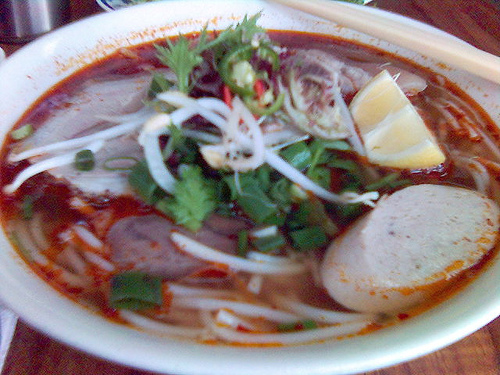
1. Bun Bo Hue – Hue Beef Noodle Soup


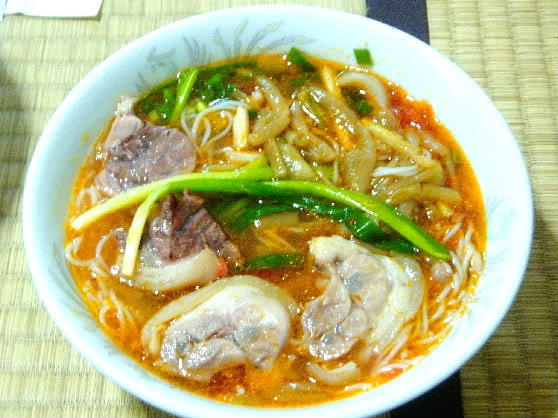
I said that I will skip the ordinary Bun Bo, but I did not say I would skip Bun Bo Hue. It is indeed my most favorite Bun dish (or bowl) out of all even though it is most likely that I will have to drink 3 cups of water in the end. Obviously, Bun Bo Hue comes from… Hue! No surprise here. This delicious and super spicy bowl of Bun includes a handful of stuff in it: boiled pork meat, pork knuckle, beef, Hue meat cake, and even pig blood. The flavor that makes Bun Bo Hue stand out from the Bun crowd is its spiciness. As you may already know, the Central Vietnamese people are famous for eating spicy foods.

2. Bún Hen – Stir Fried Baby Clam Noodle
Bun Hen is another Bun dish from the Central of Vietnam. As the matter of fact, I believe Bun originates from the Central of Vietnam and it has been used widely only in the Central and North Vietnam. The preparation for Bun Hen is quite simple but its taste contains all the meaning and characteristics of the Central Vietnamese people: simple but deeply passionate at everything that they do.

3. Bún Cha Giò / Thit Nuong – Eggroll/Grilled Pork Noodle

This is probably the only Bun dish that I can think of from the Southern Vietnamese food menu. Like the name says, the noodle bowl is topped with egg rolls and grilled pork. After you added a few scoops of sauce, you are all set to satisfy your hungry tummy.

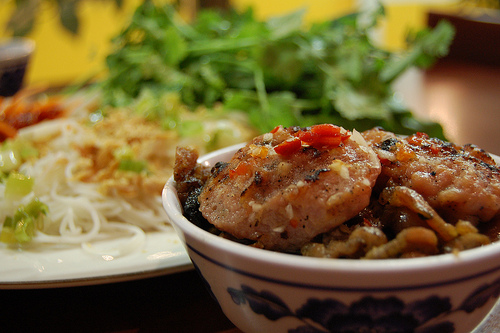
4. Bún Cha Hà Noi – Hanoi Grilled Pork Noodle
This dish is also known as “Bún Cha Quat Dong Xuân” because it first came from the Dong Xuan market area in Hanoi. Many people have mistaken this dish with Bun Thit Nuong from the South. The difference between the two dishes lays in several factors. First, “Bun Cha Ha Noi” has grilled pork meat balls besides the grilled pork slices. Secondly, the meat is marinated with different ingredients and seasoning. Lastly, rather than stirring the noodle and the meat altogether before you serve, “Bun Cha Ha Noi” requires the person to pick each item in small portions and combine them for one piece in an elegant manner. This way, you can accurately evaluate which ingredients of the dish have reached the standards and which have not. The term “Cha Quat” comes from the fact people grill the pork and meat balls by fanning them on top of the flaming charcoals.

5. Bún Riêu Cua/Oc – Crab Paste & Snail Noodle Soup

Bun Rieu in general is a Vietnamese vermicelli soup that usually contains a lot of tomato in its soup base. The toppings are made out of crab paste or snails. Most of the time, you would see both crab paste and snails together in one Bun Rieu bowl. Due to the scarcity of freshwater paddy crabs in the U.S, the American-Vietnamese people have replaced the crab paste with shrimp paste. Although shrimp paste does not bring the same tasty flavor as freshwater crab paste, but it is the closest alternative out there.

6. Bún Cá Nam Dinh – Nam Dinh Fish Noodle Soup
When people talk about Bun Ca, they often talk about Bun Ca from Hanoi or Hai Phong. I have tried them all, but nothing beat the heaven taste of Bun Ca Nam Dinh. Nam Dinh is a smaller city located about 100 miles away from Hanoi. Bun Ca Nam Dinh contains both the sweetness that you will find Bun Ca Hai Phong and the tenderness of the fish filet in Bun Ca Ha Noi. What makes it stand out from the other two competitors is the secret formula that Nam Dinh people use to prevent the fish segments become too dried from deep frying but still maintain its super crunchiness while being dipped into the broth. Especially, just from sniffing the odor from far away already making everyone salivates.

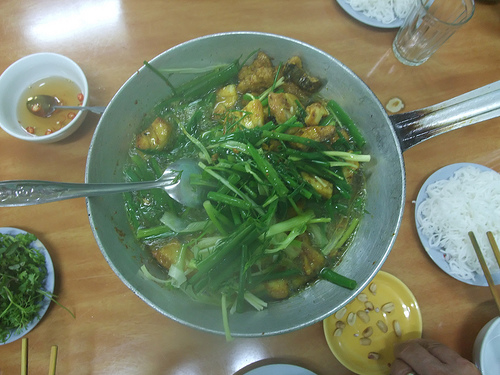
7. Bún Cha Cá Lã Vong – La Vong Fried Fish Noodle

Let’s move back to Hanoi because we cannot miss this. Bun Cha Ca La Vong is a dish that has grilled fish filets that get pan fried again when being served with Bun and other vegetables. There have been many restaurants try to put this dish on their menu but mostly unsuccessful. You maybe are questioning about the name of the dish right now. To be honest, I originally thought it was a Chinese food that the Vietnamese have adopted because the name of La Vong belongs to a famous character in China about a few thousands years ago. However, after a bit of research, I was able to find out that the Vietnamese family who invented this dish always has a small statue of La Vong sitting in front of their house. So, instead of calling it “Bun Cha Ca” just like any other ordinary Bun Cha Ca being served in the town, people stick the name “La Vong” to make it special for its superior delicious taste.

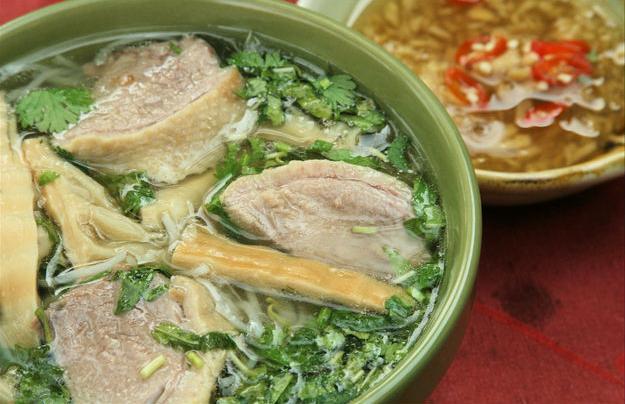
8. Bún Vit Xáo Mang – Duck ( Bamboo Noodle Soup)
This bowl of noodle soup is perfect for a cold night in the winter. Although it takes a bit of effort to make, Bun Vit Xao Mang always brings to the Northern Vietnamese families the warmth of love and the sweetness of duck broth. Nowaday, Bun Vit Xao Mang has become quite popular in many areas outside of North Vietnam.

9. Bún Bung – Bung Noodle Soup


I cannot find any better English translation for this bowl of noodle as I don’t even fully understand the meaning of its name in Vietnamese. Opposite from Bun Vit Xao Mang usually being served in the winter, Bun Bung is best eaten in the summer. It brings the coolness from various vegetables such as: tomato, Alocasia odora, green papaya, tamarine, and green onions. The broth is slowly cooked with fresh pork ribs. In addition, Bun Bung is topped with pork knuckles and pork meat. Most of the times, tumeric powder was used to create the yellowish color making the food more appealing.

10. Bún Thang – Ladder Noodle Soup
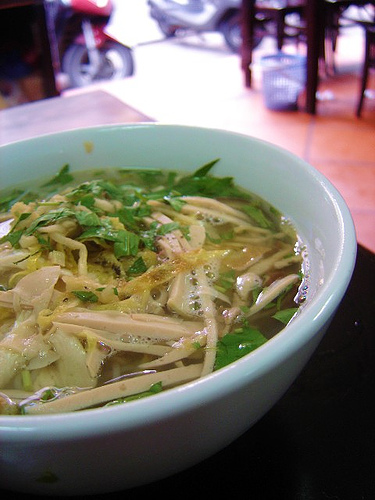
“Ladder Noodle Soup” would be the straight translation from the Vietnamese name of this noodle soup that originates from the North of Vietnam. I have heard many explanations for its unique name, but I think the most accurate and simple one would be the following: “Thang” is a Chinese word for “Broth” or “Soup”. Since Vietnamese people were borrowing Chinese language in the past, it is most likely that they were just trying to say this is “Noodle Soup”. The name sounds simple but it takes tons of time to prepare this bowl of noodle. The ingredients include: shredded chicken meat, shredded fried egg, shredded steam pork cake, and various vegetables. To cook the broth, you would need both pork ribs and a whole chicken. Bun Thang requires a lot of time to make, but it is easy to eat and very nicely decorated as you can see from the picture.

Pho hanoi


Beautiful smile

What to Eat in Vietnam

Vietnamese Food

In the past few years Vietnamese food has become more and more popular around the world. Food lovers may have tried the two best known Vietnamese dishes – spring rolls and bread rolls. Rice, noodles, fresh vegetable and herbs all play big roles in Vietnamese food, making it one of the healthiest cuisines in the world.

In Vietnam you’ll discover one unmistakable fact: Vietnamese people love noodles. They eat them every day, sometimes for every meal. Vietnamese noodles are made from a few basic ingredients, the most common being rice, wheat and mung beans, but a whole sub-cuisine is built on these basics.

Food in Vietnam

What’s in Vietnamese Food

In the northern part of the country, thanks to the influence of neighbouring China, people tend to use more soy sauce than other parts, where fish sauce is more usual. Other common ingredients in Vietnamese cooking include black pepper (mainly in the north), hot chili, coconut milk, limes, lemon grass, tamarind and cane sugar, supplemented by asparagus and potatoes, courtesy of the French influence. Methods of cooking vary from simmering or boiling to frying or grilling.

Stir-frying using a wok and chopsticks is common. Many European influences can be found in Vietnamese dishes, including sauces, meats, cold roast pork, patés and baguettes (French rolls). At the other end of the scale, in some parts of the country there is still plenty of demand for exotic meats such as dog, turtle and snake.

Halong tourism festival

Photo courtesy of TTD Ha Long Tourism Festival opened Saturday at Bai Chay Ferry Station in the capital of northern Quang Ninh Province, drawing more than 10,000 guests.

More than 3,000 professional and amateur actors and actresses took part in a street parade.

Other highlights were an exhibition of 10 model cars decorated with flowers, six large moving stages, 100 tourist vessels, dragon boats and dragon ferries.

The grand finale was a fireworks show on Bai Chay Bridge in Cua Luc Bay.

12.13.2010

Vietnam to waive visa for Russian visitors

Russian nationals will be exempted from visa when entering Vietnam within 15 days from January 1, 2009, according to a decision of the Vietnamese Prime Minister.


Russian nationals will be exempted from visa when entering Vietnam within 15 days from January 1, 2009, according to a decision of the Vietnamese Prime Minister.
The fresh decision will apply to Russian ordinary passport holders regardless of the purpose of their visit.

In 2007, over 60,000 Russian visitors toured Vietnam, and the number is forecast to reach 70,000 this year, the National Administration for Tourism said.

At present, in addition to daily non-stop flights linking Russia and Vietnam, travel companies charter flights to Vietnam once or twice a week.

Related Posts Plugin for WordPress, Blogger...